ABOUT STCP
PROGRAM OVERVIEW
There are two relevant documents available as .pdf files.
Please click on the respective icon to display or download your choice: -
- Program Brochure
(235 kb)
- Detailed version of this page
(93 kb)
[Note: To read .pdf files you will need Adobe Acrobat Reader. If you do not have it installed on your computer, click on our tools page, where links for downloads are provided]
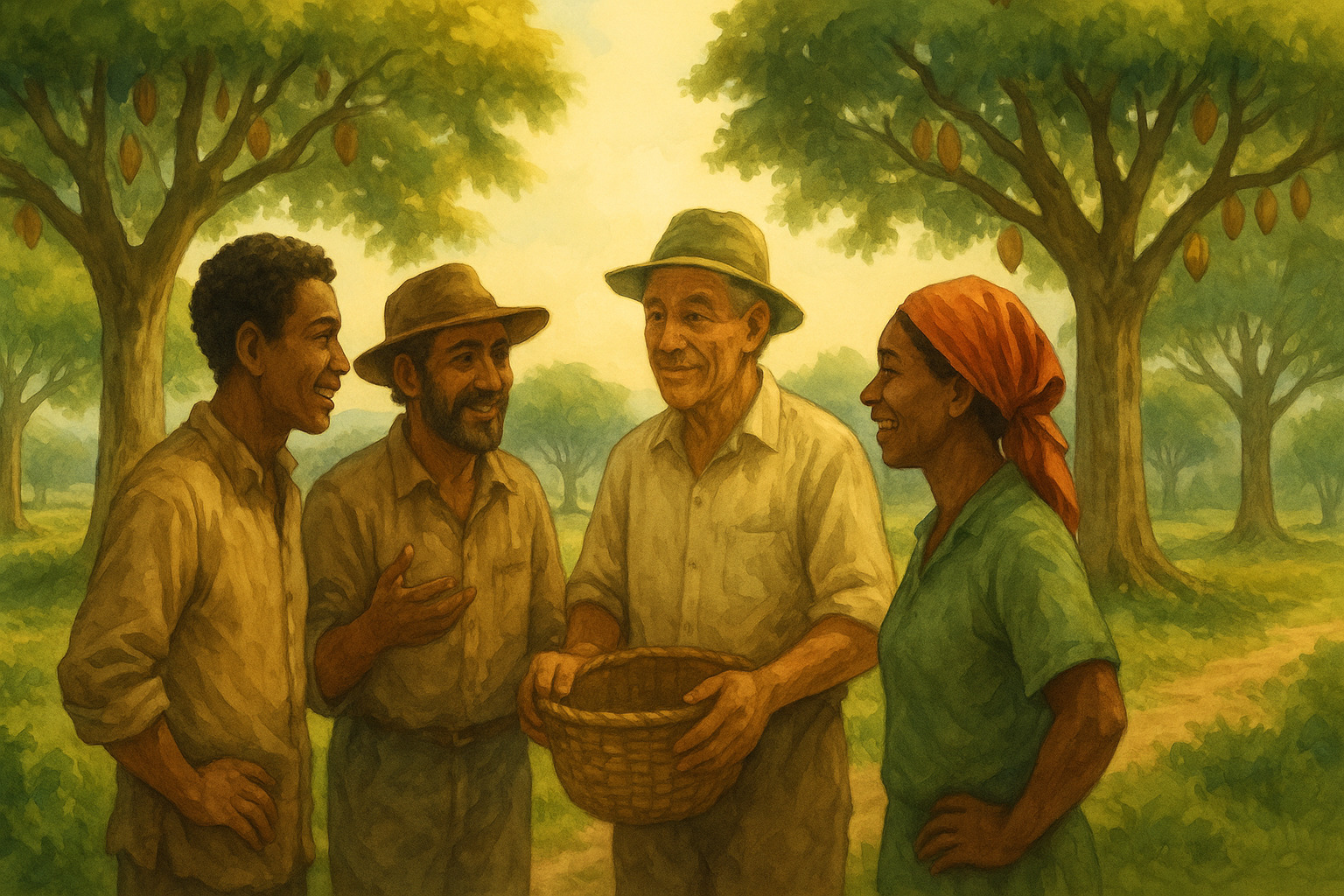
The Sustainable Tree Crop Program (STCP) constitutes a coordinated and innovative effort made by farmers and producer organizations, the worldwide chocolate industry and trade, national governments, research institutes, the public sector, policymakers, donors and development agencies to facilitate the improvement of smallholder agricultural systems based on tree crops in West Africa. With over 50% of the foreign exchange derived in West Africa coming from cocoa alone, it is clear that there are numerous groups now involved and committed to the tree crop commodities.
Collectively, these groups, which typically bring different perspectives to the table, have shaped consensus around three common interests and concerns. They include:
- promoting the production and marketing of quality cocoa,
- improving market access and income for small-scale producers, and
- creating systems that are environmentally friendly, socially responsible, and economically sustainable.
STCP Goal
The goal of STCP is "to improve the economic and social well being of smallholders and the environmental sustainability of tree crops farms." To achieve the STCP goal, a public - private sector partnership was created - the STCP West African Development Alliance - to provide stakeholders with an organizational framework and policy environment under which they could improve the performance and efficiency of the system.
If STCP is successful, the outcome of these efforts will be a more sustainable global economy for the focal tree crop systems, characterized by: increased rural incomes, reduced risk and greater stability in the supply of quality products to end users, increased demand for and use of tree crop products, better working conditions on farms, and an improved status of environmental resources for current and future generations of West Africans to pursue their interests.
STCP Results Framework
STCP is a program that brings together interested stakeholders and enables them to collaborate. To do this efficiently, a results framework with five strategic areas was adopted:
- strengthening community-focused groups,
- technology dissemination and research,
- policy change and implementation,
- market system and information system development, and
- labor and social systems.
The general approach being taken within each strategic area is to build on the existing efforts and activities of relevant stakeholder groups, to add value to them, and to co-ordinate future collaborations. Currently, the primary tree crops targeted by STCP in West Africa are cocoa and cashew nuts. Additional tree crops may be considered within the context of diversification of cocoa or cashew production systems.
STCP Regional Program
STCP has been developed as a regional program in order to enhance the synergies to be gained by working across institutions and countries to successfully develop sustainable tree crop production. The four largest African cocoa producers (Cameroon, Cote d'Ivoire, Ghana, and Nigeria) are included in the program and account for approximately two-thirds of total world production. The fifth member of the program is Guinea whose diversified agricultural economy includes cocoa, cashew and robusta coffee as major sub-sectors.
Three "cross-cutting" regional projects have been developed to support the national pilot projects:
- Child Labor,
- Technology Delivery, Research and Impact, and
- Trade and Information Systems.
These projects are being developed by organizations with the necessary expertise and capabilities in the respective areas.
STCP Pilot Projects
Currently, a series of STCP pilot projects are beginning in West Africa; three pilot project sites have been identified in Cote d'Ivoire, and one in each of the other four countries (Cameroon, Ghana, Guinea, and Nigeria). The objective of these pilot activities are to compare, test, and validate different approaches and interventions to develop sustainable and integrated cocoa production systems, and to concurrently address child labor concerns in a coherent and systematic method. The ultimate goal of these pilot activities is improve the rural livelihood of cocoa producers in West Africa by improving their ability to respond to the demands of global markets.
STCP Management
Finally, a regional program management structure has been developed to support and link the pilot projects and regional activities. The International Institute of Tropical Agriculture (IITA) is hosting the STCP regional program and will manage it through the STCP Regional and National Coordination Units. The Child Labor Regional Project will be hosted and managed by the International Labor Organization (ILO) through its international program on the elimination of child labor (IPEC). The Donor Alliance Committee will ensure a broad-based public-private partnership to support STCP; a Donor Liaison office is assisting with development of communication tools and material to serve the Alliance. The STCP Steering Committee, consisting of 15 members from farmers groups, industry/trade, funding agencies, national network chairs and the program host institution is providing general oversight to the STCP program as a whole.
|